
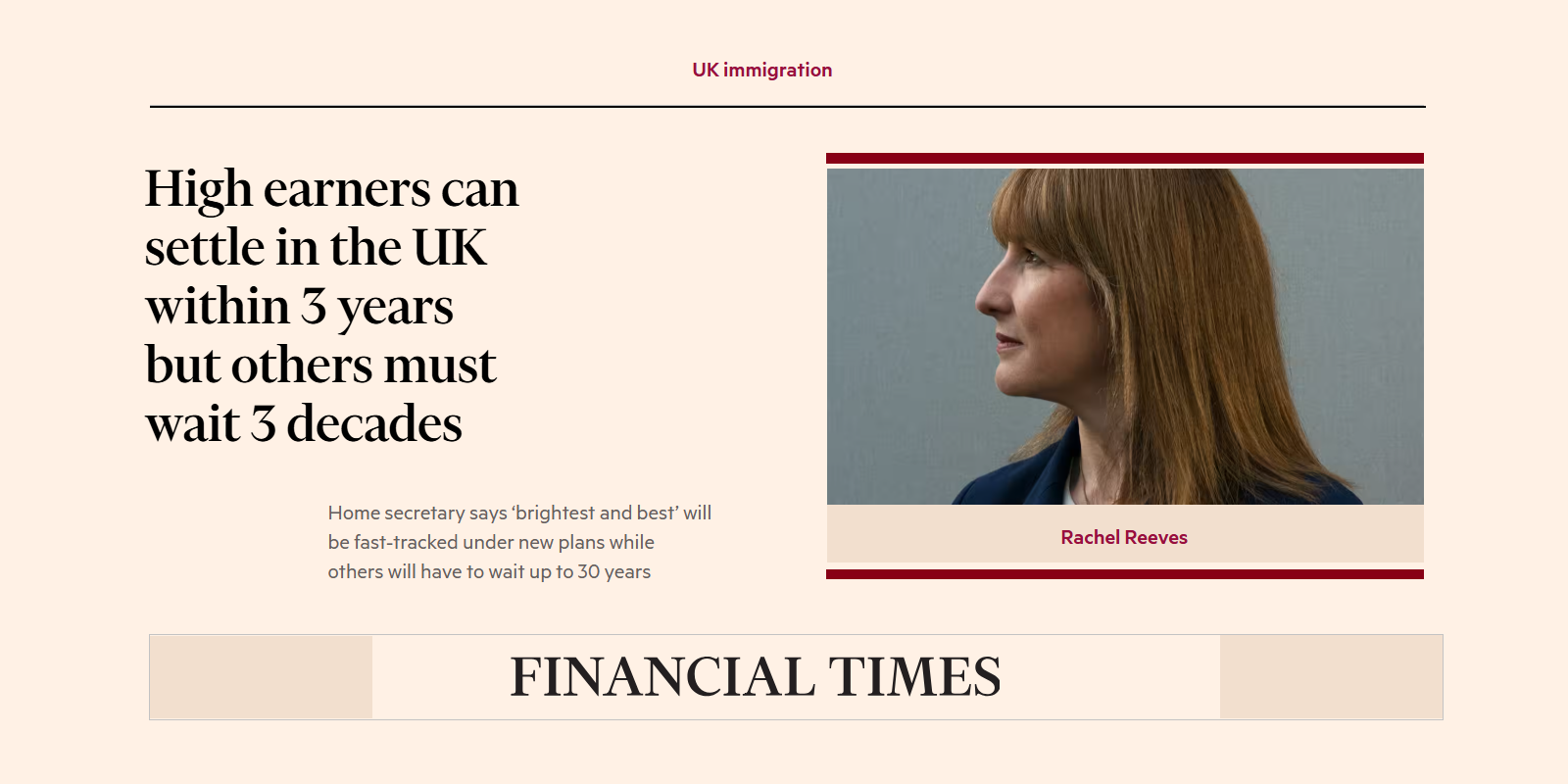
High earners to be eligible for UK settlement within 3 years of arrival
Home secretary says ‘brightest and best’ will be fast-tracked under new plans while others will have to wait up to 30 years
FT 20-11-2025 Robert Wright and Delphine Strauss in London
High earners and entrepreneurs will be eligible for UK settlement in as little as three years while others will be forced to wait three decades under government plans to transform the legal migration system.
Home secretary Shabana Mahmood on Thursday called the changes the “biggest overhaul of the migration model in 50 years”. At present, most migrants can apply for permanent status after five years.
The proposed reforms come days after Mahmood announced plans to change the asylum system by making asylum status temporary for many people and ending the automatic right to housing and financial support.
Appointed in September, Mahmood has moved quickly to make Britain less attractive to most migrants as the government seeks to fend off Nigel Farage’s anti-immigration Reform UK, which is leading in opinion polls.
The Home Office said the most attractive terms under the new system would be available to people earning more than £125,140 and those on global talent and innovator founder visas.
They will be able to settle after three years, while people earning more than £50,270 will have a five-year path.
But the reforms, set out in a policy document, will slow the path towards permanent settlement for the roughly 2mn people who have come to the UK via legal routes since 2021, a time of record net migration to Britain.
“The intention is that anyone yet to be granted settlement would be subject to the contribution-based model once the new rules are in force,” the Home Office said in a statement, while stressing that people who already had settled status would be unaffected.
Madeleine Sumption, director of Oxford university’s Migration Observatory, called the proposals a “radical” shift that would make the UK’s rules on settlement “considerably more restrictive than comparable high-income countries”, though with varying effects on different groups.
Under the new system, the default qualifying period would be 10 years for most migrants in graduate jobs, provided they met English language requirements and were paying national insurance.
The default period for migrants in non-graduate roles will be 15 years. The Home Office said this category included the 616,000 care workers and their dependants who arrived in the UK between 2022 and 2024.
Sumption said care workers looked to be “the single biggest target” of the policy changes, which would keep them in temporary status for up to 15 years, preventing them moving into other sectors.
The 15-year route also looks likely to apply to hundreds of thousands of skilled worker visa holders who came to the UK before 2024 in mid-skilled roles — as welders or chefs, or in more junior roles in tech, HR or marketing.
But higher earners, public sector workers such as doctors, nurses and teachers and those with a record of community volunteering will be able to shorten their route to settlement by five years from these baselines.
People married to British citizens and people who came to the UK under the Hong Kong British National (Overseas) scheme, would also retain their right to settlement after five years, the Home Office said.
Any migrants reliant on benefits would have to wait 20 years, although most are already barred from receiving public funds until they have settled status.
The proposals added that, in future, immigrants would be eligible for benefits and social housing only after becoming citizens — typically possible a year after a grant of settled status.
People who overstayed their visas and other people with no legal right to be in the UK would have to wait 30 years, the Home Office said.
Marley Morris, an associate director at the think-tank IPPR, said the plans would leave refugees with “no real incentive to integrate” but were “relatively reassuring” for employers, since they would not change the timeframe for most people newly hired on skilled worker visas.
The Home Office made it clear that none of the proposals would affect the millions of EU and European Economic Area citizens in the UK covered by the Brexit deal between London and Brussels. They will continue to have a five-year wait to be eligible for permanent settlement.
Much less clear is what the proposals will mean for the families of people who come to the UK on work visas, who usually qualify for settlement at the same time as the worker at present.
The Home Office said dependants of the main visa applicant would in future qualify according to “their own attributes and circumstances”, potentially on a shorter or longer timeframe, though there will be some leeway for children who turn 18 before their parents qualify for settlement.
This suggests that partners of even the highest earners would need to be in work in order to qualify for settlement even after 10 years.