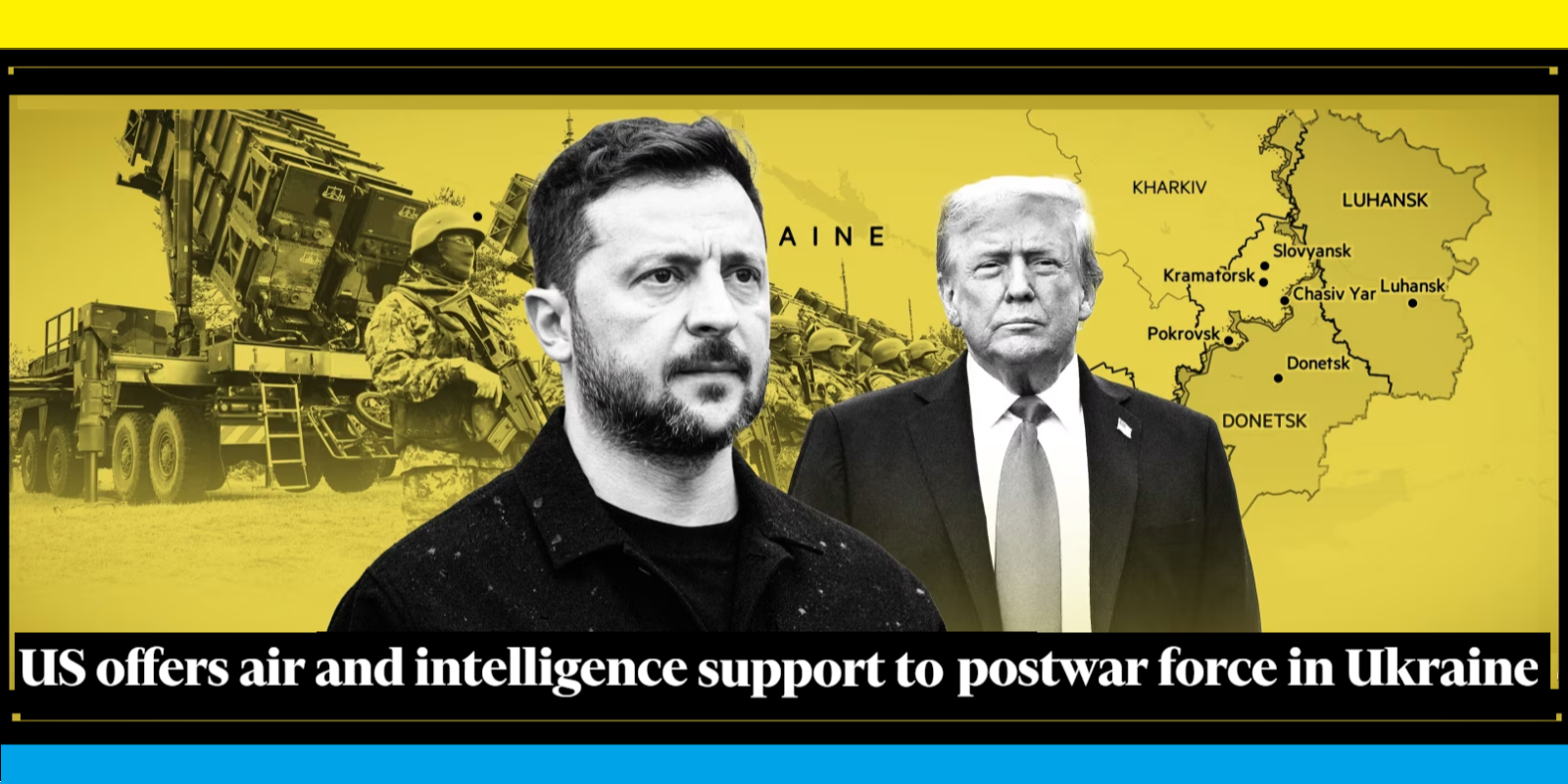
© FT montage/Getty Images
US offers air and intelligence support to postwar force in Ukraine
Washington prepared to contribute surveillance, command and control and air defence assets, say European officials
Henry Foy in Brussels, Christopher Miller in New York and Steff Chávez in Washington © FT 25-08-2025
The US has said it is prepared to provide intelligence assets and battlefield oversight to any western security plan for postwar Ukraine and take part in a European-led air defence shield for the country, European and Ukrainian officials said.
US President Donald Trump told European leaders last week America would be part of “co-ordination” of security guarantees for postwar Ukraine, something Kyiv has demanded to deter a future attack from Russia after any peace deal.
Senior US officials have since told European counterparts in multiple discussions that Washington would be prepared to contribute “strategic enablers” including intelligence, surveillance and reconnaissance (ISR), command and control and air defence assets to enable any European-led deployment on the ground, four officials briefed on the talks told the Financial Times.
A so-called coalition of the willing, led by the UK and France, has vowed to protect postwar Ukraine from any future Russian aggression.
But European officials have privately admitted that any deployment could only take place with US support to enable, oversee and protect European troops.
Washington already supplies Ukraine with Patriot air defence missiles, but the postwar support would involve US aircraft, logistics and ground-based radar supporting and enabling a European-enforced no-fly zone and air shield for the country, the officials said.
Under any peace deal, the US’s vastly superior intelligence, surveillance and command and control capabilities would enable satellite monitoring of a ceasefire and effective co-ordination of western forces in the country.
The US offer, voiced in a flurry of meetings between national security officials and military leaders from the US and major European countries in recent days, is contingent on commitments by European capitals to deploy tens of thousands of troops to Ukraine, the officials cautioned.
It could still be rescinded, they said. But it represents a significant shift in stance from the Trump administration — which earlier this year ruled out any US participation in protecting post-conflict Ukraine — and has buoyed European officials who have spent months lobbying Washington to lend more support to Kyiv.
Trump has pushed the two sides to agree a peace deal, but Moscow and Kyiv remain far apart on key details, including postwar territorial control and security guarantees. Russian President Vladimir Putin has insisted any such guarantees must involve Russia, a non-starter for Ukraine.
Ukrainian President Volodymyr Zelenskyy, left, at the White House meeting with President Donald Trump and European leaders earlier this month © Andrew Caballero-Reynolds/AFP/Getty Images
The US remains opposed to deploying its own troops to Ukraine, the officials added. Other Trump administration officials, including defence secretary Pete Hegseth, are sceptical of any participation in postwar guarantees for fear it would drag the US into future conflict.
The Pentagon referred questions to the White House and to a Monday statement by Trump on security guarantees, but said the measures reported by the FT “are pre-decisional, and the Defense Department will not comment on pre-decisional topics”.
A White House official said: “President Trump and his national security team continue to engage with Russian and Ukrainian officials towards a bilateral meeting [between Putin and Ukrainian President Volodymyr Zelenskyy] to stop the killing and end the war.”
They added: “It is not in the national interest to further negotiate these issues publicly.”
Trump said on Monday that “we haven’t even discussed the specifics of” security guarantees for Ukraine. “We’ll be involved from the standpoint of backup. We’re going to help them,” he told reporters.
He told Fox News last week that the US was “willing to help” a European force “especially, probably, by air”.
Western capitals have sketched out a rough plan that would involve a demilitarised zone, possibly patrolled by neutral peacekeeping troops from a third country agreed by Ukraine and Russia.
A far more robust border behind that would be defended by Ukrainian troops armed and trained by Nato militaries, three of the officials said.
A European-led deterrence force would then be stationed deeper in Ukraine as a third line of defence, with US assets supporting that from the rear.
But even with potential US backing, the public and politicians in many European countries remain nervous about possible troop deployments to Ukraine.
Defence secretary Pete Hegseth is one of those sceptical of any US participation in postwar guarantees © Alex Brandon/AP
Trump’s peace push has so far achieved limited results. The Kremlin has rejected a Trump proposal that Putin meet Zelenskyy to discuss peace, while the Russian president has pursued maximalist demands — including on territory — that would cross red lines for Ukraine.
European Commission spokesperson Paula Pinho said on Tuesday: “After the meeting in Washington last week . . . one of the takeaways was to task the national security advisers to look into how security guarantees could look, concretely. We should soon be hearing from that group on . . . what will be put forward.”
Zelenskyy said his military leadership had briefed him “on work with all partners within the coalition of the willing”. “The pace of work must be accelerated,” he said. “The defence component of the security guarantees must be detailed in the near future.”